The Double Assassination Attempt and Gunfight in the Desert
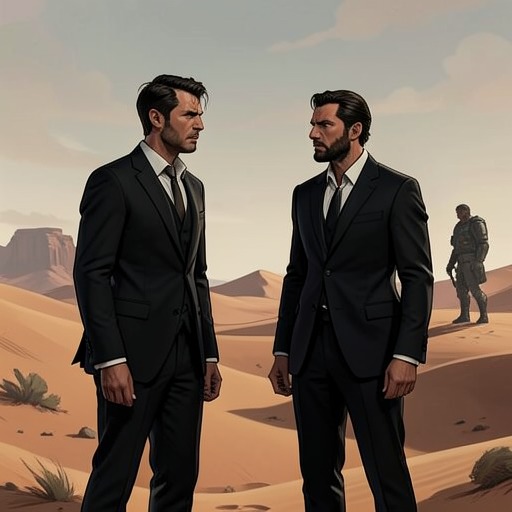
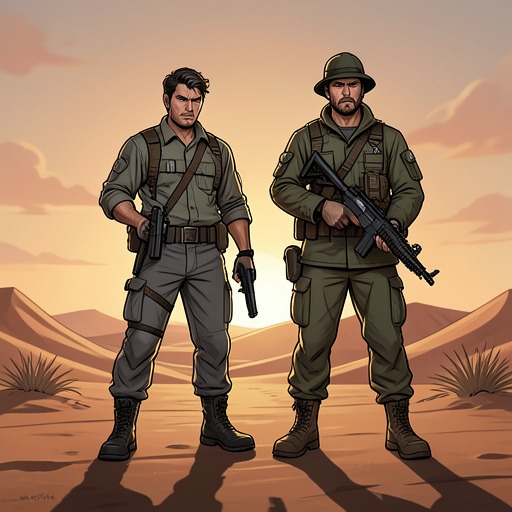
Mr. & Mrs. SmithThe Double Assassination Attempt and Gunfight in the Desert is the collision of two covert operations in the desert north of the Mexican border. Jane Smith has prepared a timed minefield for a convoy, while John Smith has set up to attack the same procession with a Javelin. Neither knows at first that the apparent obstacle to the mission is the other agent. Their confrontation turns a carefully controlled double assassination attempt into a chaotic exchange of fire, an explosion, and the escape of the convoy.
Two operations converge
Jane’s plan depends on timing and terrain. Watching a convoy of SUVs approach along a faint, sand-covered road, she reports its progress to her team over the radio. A simple time bomb is connected to cables laid in the desert ground, and a grid on her laptop marks twenty white points across the broad killing zone. She waits until the convoy is close before activating the plan: the vehicles appear to be heading directly into the danger area, with about a minute remaining.
John is watching the same convoy from a high ridge, roughly eight hundred metres away. He is in the desert north of the Mexican border, where the view gives him time to open his lunchbox before the vehicles arrive. He takes out sandwiches and a piece of lemon cake, then turns his attention to the convoy’s heavily armed centre. His response is a portable Javelin CLU 76-millimetre launcher, which he shoulders and aims using its laser sight and integrated thermal viewer.
The contrast between the operations is immediate: Jane has prepared a wide, pre-set trap beneath the convoy’s route; John is tracking the vehicles with a shoulder-fired weapon. Each believes the mission is under control. Their targets and positions, however, bring them into the same field of fire, and Jane recognizes that the man with the launcher is hunting her husband.
The first shot changes the target
Jane shifts her aim from the convoy to the man preparing to fire at it. Taking a silenced rifle from the strap on her back, she steadies it on the buggy driver and shoots. The shot interrupts John before he can carry out his attack, but it does not kill him: his trained body reacts before he can think, and he drops into the sand. The bullet has only grazed him, taking off part of his right ear. He remains alive, bleeding and furious, while the desert offers no hiding place and no route of escape.
The sudden gunfire also disrupts Jane’s timed operation. The convoy, alerted by the fight between the two agents, speeds away into the distance instead of continuing through the prepared killing zone. The trap had been set for the vehicles, but the clash has made them abandon its path. John does not know who shot him or whether the other agent survived; he leaves determined to discover the attacker’s identity and, if the person is still alive, make them regret it. In the rubble of an old mine, a light flickers among the wreckage: Jane’s laptop has survived the blast and is still working.
The blast and its aftermath
John’s attempt to answer the attack turns the desert into a second trap. He wipes down the Javelin and aims it at his target; the heat-seeking missile ignites several metres after launch and races toward the person trapped in the mine shaft. The old mine erupts into fragments. John stares at the weapon in his hand, startled by the force of the explosion, but the blast also shakes the ground beneath Jane and throws her down through a cloud of dust. The apparent success of his counterattack does not settle what happened between them: Jane has no clear view of John’s fate, and John cannot tell whether his unseen assailant is dead or alive.
The explosion also destroys the timing on which Jane’s convoy operation depended. Her minefield had been designed to detonate as the vehicles crossed its zone, but the agents’ gunfight alerts the convoy, which speeds away before reaching the intended danger area. The attack on John and the trap for the vehicles thus interfere with one another: Jane’s shot saves the convoy from entering the killing zone, while John’s response produces a spectacular blast without resolving the personal threat between the two agents. For John, the interruption ruins the day’s work and leaves a new objective in its place: he vows to learn the other agent’s name and, if that person is alive, make them wish they had died in the explosion.
Domestic life as a counterpoint
The desert encounter belongs to a larger pattern in which the couple’s covert work and their marriage repeatedly occupy the same frame. At home, even a small shopping failure exposes the mismatch between Jane’s precise requests and John’s understanding: he brings salted butter when she asked for unsalted, and she dismisses his attempt to apologize by saying she will improvise. The exchange ends with Jane trying to change the subject to new living-room curtains, met by John’s flat response. That clipped domestic rhythm makes the desert’s misdirected violence feel less like an isolated accident than an extreme form of their everyday failure to read one another.
The contrast is sharpened by their respective professional performances. Jane can tease a client in a deliberately flirtatious voice, while John turns an assassination into self-commentary, narrating the convoy’s heavily armed centre as though he were a sports announcer before presenting the Javelin as his answer. Such playfulness does not soften the danger; it shows how readily each agent can convert violence into routine or performance. In the desert, however, the two separate performances collide. Jane sees the man with the launcher and understands that he is hunting her husband; John, shot before he can fire, does not know who his attacker is.
The same uneasy mixture of intimacy and destruction recurs later at home. During their armed confrontation, John’s shots smash the kitchen’s glasses and cabinets and destroy the teapot Jane treasured, along with its matching kettle. Jane pauses to take in the ruined room before turning back toward him. Domestic objects that once marked ordinary life become casualties of the fight, just as the lemon cake John associates with nights abroad briefly accompanies his desert mission. The juxtaposition gives the desert episode its larger resonance: for the Smiths, the boundary between household routine and lethal work is not secure, and even the signs of shared domestic life can be carried into, or shattered by, their professional conflict.
This collision of registers continues when the pair later flee through a home-goods store under attack. A life-size store mascot, Homey, springs from a box of teddy bears armed with a sawed-off shotgun; Jane and John shoot its stuffed head, and its gun blasts the ceiling as it falls. A covert confrontation becomes a public disturbance in a setting stocked with domestic merchandise. The desert gunfight, the wrecked kitchen, and the store escape all turn familiar objects and settings into part of the action, making the couple’s double life visible through the damage it leaves behind.